Cotton cooperators, gin managers, demo plots help with planting decisions

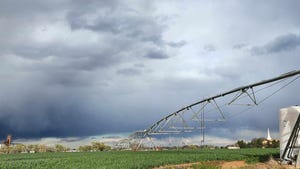
  • Weather always plays an important role in crop production.
  • Producers must choose crops capable of utilizing every drop of moisture while producing top yields of high-quality products earning the highest price available at harvest.
  • Producers face difficult choices.


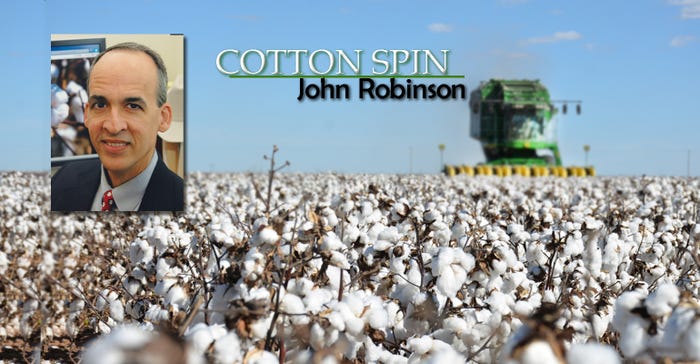
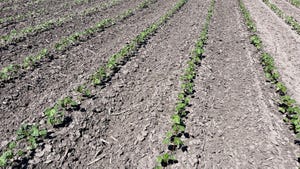
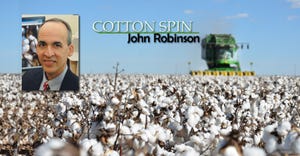
WITH COTTON, a little water makes a real difference in how much is harvested. This good field of white cotton is part of a research project carried out by Dr. Randy Boman, Oklahoma State University research director and cotton Extension program leader, with Merlin Schantz, a cooperating famer who lives near Hydro, Okla. Boman is also working with the Farmers Cooperative Gin in Carnegie to obtain information on the harvested cotton.

Randy Boman

Weigh wagon

After harvesting selected cotton variety plots, Boman, along with his staff, Shane Osborne and Larry Bull, used a Lee weigh wagon to take cotton test samples. The wagon is a boll buggy fitted with integral digital scales that enables them to conduct replicated large-plot trials.

"Before the cotton is removed from the weigh wagon to be made into modules, we get what we call ‘grab samples,’ which are ginned on research equipment and then sent to the Fiber and Biopolymer Research Institute at Lubbock, Texas, for high volume instrument testing of the fiber properties," Boman said. "With assistance from our cooperators and ginners, we get detailed information when the variety modules are ginned at the Farmer’s Cooperative Gin at Carnegie. By interpreting this information, we get commercial data on gin turnout, yield and USDA-AMS classing results."

Information available from the Carnegie gin gives Boman "a high quality snapshot of cotton fiber qualities," he said.

Management at the Carnegie gin takes a lot more intricate information from the ginning process through improved computerized technology created by Gin Manager Jeanie Hileman's two ginners, Aaron Hileman and Dalton Skinner. "Both of them have extra math and electronic knowledge that has helped them program the gin’s computers to get extra data for our customers," Hileman said.

"We are able to give our customers extra information on their spreadsheets so they can see how their cotton is grading and ginning. We can get a better handle on which cotton variety is easier to gin: Is it harder to press into a bale and thus, cost us more energy to do so?"

Before cotton harvest, Boman worked with Schantz and other producer/cooperators across the state to plant replicated agronomic cotton evaluation trials.

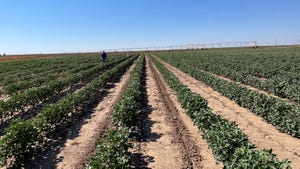
"At Merlin's farm, we planted PhytoGen 499 WRF, Deltapine 1219 B2RF, FiberMax 1944 GLB2, Stoneville 4288 B2F, All-Tex Nitro 44 B2RF, Americot 1511 B2RF, NexGen 4012 B2RF and a grower standard for comparison, FiberMax 1740 B2F," Boman said. "We planted three replications of each variety with each variety having eight rows. These rows were planted across a quarter-section field watered with a pivot system. At harvest, Merlin harvested an area 500 feet long of each variety. This cotton was then transferred into the weigh wagon, samples were taken, the remaining cotton for each variety was placed into individual modules, brought to the Carnegie gin and we are getting additional data from the gin's computer now."

Boman and his staff will take this data, along with similar information from other sites, for several more years. He believes information gleaned from this research will give valuable information to farmers on what varieties offer the best results to make cotton more competitive with other crops.

Cotton is known to be a crop that grows well in warm, dry climates. Due to modern genetics, it not only yields top-quality fiber to be milled into cloth but also provides by-products for human and animal consumption and for many other needs.

Discuss this Article 0

Post new comment
Sign In or register to use your Southwest Farm Press ID
(optional)

Continuing Education Courses
This CE course is accredited for hours in Texas, Oklahoma and New Mexico. The content focuses...
New Course
The 2,000 member Weed Science Society of America’s (WSSA) Herbicide Resistance Action...
New Course
The course details six of the primary diseases affecting citrus: Huanglongbing (Citrus...

Newsletter Signup