Watch for insect pests as cotton begins to mature

Aug 3, 2009 10:48 AM, By Vic Schoonover, NTOK Cotton

As cotton matures and changes, so do the pests challenging its productivity. J. Terry Pitts, Oklahoma State University Extension specialist, entomology, integrated pest management, offers an update on the 2009 cotton growing season:

"We are at or past the first bloom stage in almost all cotton fields. Cotton will no longer be vulnerable to cotton fleahoppers once the cotton begins to bloom. It is now time to look at midseason pests,” Pitts says.

"We are seeing large numbers of bollworm moths but current cotton varieties contain the Bt gene and are not vulnerable to yield-limiting worm damage.

He cautioned growers to watch for two pests that occasionally occur in cotton, cotton aphids and spider mites. “Cotton aphids are small, soft bodied insects commonly referred to as 'plant lice.' Aphids can occur on cotton in such high numbers that control methods should be implemented. Buildups are localized and usually occur after cool, damp weather or during the season after the use of certain insecticides.

"The insects are found on the underside of leaves and along the terminal stem, causing misshapen leaves with downward curl and stunted plants. The insect damages cotton directly by sucking juices from the plant and indirectly by secreting honeydew. The honeydew is slick and can lower the grade of cotton lint. A sooty mold can grow on the honeydew, further damaging the lint.” Pitts says.

"Cotton aphids can be controlled with chemical applications, but the number of beneficial insects should be taken into consideration before using a spray. It is often best to determine the aphid population level and also count the numbers and type of beneficial insects. The following week, similar counts should be made. If the aphids are not increasing in numbers, then allow the beneficials to do their job. If aphids are increasing two to three times over the last count, then a chemical application should be made. If you used a seed treatment insecticide, do not apply the same class of chemistry (such as Centric, Provado and Trimax).”

Pitts says using the same class of chemistry can result in poor control and additional spraying. “In addition, use the highest rate suggested for good control and avoid the use of pyrethroids as they can cause aphid outbreaks by removing beneficials.

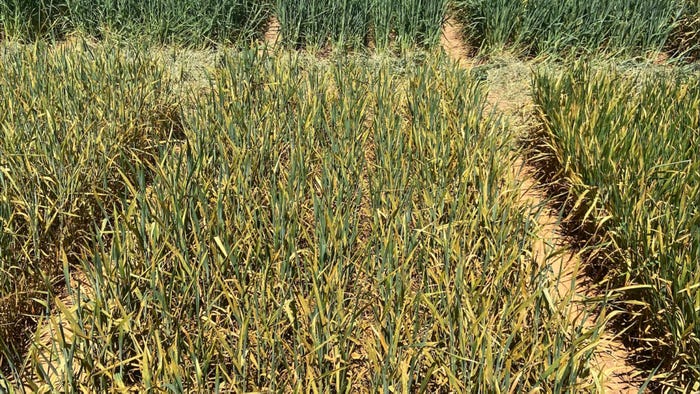
"Spider mites can be distinguished from insects by their eight legs instead of six. Spider mites often attack cotton when insecticides have destroyed beneficial insects. Infestations are often aided by hot, dry weather. In most cases, infestations will be localized in a field. Spider mites damage cotton by feeding on the plant juices. Foliage will turn a reddish or yellow color with a heavy infestation. Mites are small and generally found on the underside of leaves. A close inspection is necessary to determine if mites are present.

"Chemical control should be used only if a population increase is not being held by beneficial insects,” he says. Bidrin, Captone, Comite, Cygon (Dimethoiate), Caracron, Kelthane, Zephyr and Oberon are all registered for spider mite control.

COTTON GROWTH TIMETABLE

State of growth GDD Days
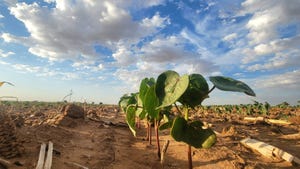
Emergence 50-60 3-4
Pinhead square 425-500 25-45
First bloom 725-825 41-67
Open boll 1575-1925 102-127
Defoliation 2150-2300 120-140


TALKIN' COTTON is produced by NTOK Cotton, a cotton industry partnership which supports and encourages increased cotton production in the Rolling Plains of North Texas, Oklahoma and Kansas. For more information on the cotton scene, see okiecotton.org. and ntokcotton.org. For questions or comments on Talkin' Cotton, contact eventerprise1@hughes.net.

Get Copyright ClearanceWant to use this article? Click here for options!
© 2010 Penton Media, Inc.


Latest Jobs

resources

events icon events

product info icon tradeshows

tradeshow icon digests

research icon photos

Continuing Education

Accredited in Florida, Georgia, New Mexico, Oklahoma, Texas, South Carolina and Tennessee:


(New Course)
Weed Resistance Management in Cotton


This course covers a wide range of options to effectively control weeds in cotton and reduce the risk of weed resistance management. It is accredited for hours/units for licensed/accredited applicators in 7 U.S. Cotton Belt states (Florida, Georgia, New Mexico, Oklahoma, Texas, South Carolina an d Tennessee. CCA credit is pending).

(New Course)
New Mode of Action Chemistry for Vegetable Production

Integration of a new mode of action compound like Coragen into IPM and IRM programs to control Lepidoptera in leafy greens, fruiting vegetables, peppers and brassica or cole crops is always welcome. This online CE accredited course details how best to use this new mode of action insecticide in intensive vegetable production. It is accredited by the Certified Crop Adviser (CCA) program and by state agencies for licensed applicators in Texas, Georgia, Florida, New Jersey and Pennsylvania.

This course is accredited in Texas, Oklahoma, New Mexico, Virginia, West Virginia and Wyoming as well as for CCA credits:

(New Course)
Spray Drift Management

Keeping crop protection chemicals on the crop for which they are intended has been a cornerstone of farming not only to protect neighboring crops, but to not waste money allowing products to drift off the intended target. This accredited online continuing education course covers the critical elements of spray drift management.

New Course
The ABCs of MRLs

American agriculture exports 20 to 30 percent of its production annually. For specific commodities, the percentage is much higher. When recommending and applying pest management products for crops, license Pest Control Advisers (PCAs)  and applicators and farmers must be aware of which products applied are in compliance with Maximum Residue Limits (MRLs) established by foreign customers. This CE course details the MRL issue and why compliance is critical to marketing into world trade.

Back to Top

Browse Print Issues

Additional Resources

subscribe to Farm Press Daily Delta Farm Press Southeastt Farm Press Western Farm Press