Sorghums offer unique opportunity for biofuels feedstock production

Sep 22, 2008 10:31 AM, By Ron Smith
Farm Press Editorial Staff

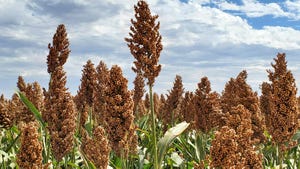
Sorghums — grain, sweet and forage — offer unique opportunities as efficient, adaptable and drought tolerant feedstocks for biofuel production.

“Sorghum can fit into all renewable fuel schemes,” said Tim Lust, CEO, National Sorghum Producers, during the International Conference on Sorghum for Biofuels in Houston. “This conference is exciting,” Lust said. “It gives us an opportunity to understand the scope of global research.”

He said sorghum has been around for many years, “but a lot of the world does not know about it.” As a potential renewable fuel source, he said sorghum offers several options: as a starch for ethanol, sweet sorghum as sugar to ethanol, and forage and sudangrasses as high tonnage biomass for cellulosic or ligno-cellulosic ethanol.

Lust said 20 percent of the current U.S. sorghum crop goes into ethanol production. “And more (ethanol) plants are coming online in the sorghum belt. We see a lot of opportunity to expand.”

Lust presented a SWOT (strengths, weaknesses, opportunities and threats) analysis of sorghum as a biofuel crop.

Strengths include drought tolerance. “Sorghum, by nature, is drought tolerant,” he said. “That provides a unique opportunity.” Studies in West Texas show sorghum can produce significant tonnage on relatively small amounts of water.

“It’s also adaptable. Sorghum bicolor (the most common sorghum) will grow in 80 percent of the world.”

He said the sorghum genome has recently been sequenced, “the second cereal to be sequenced. We now have tools available (for enhanced research).”

He said seed companies have diverse germplasm and farmer checkoff funds, recently approved, provide more research money.

“Sorghum has well-known agronomic traits and we understand the disease and insect threats. It’s a non GMO crop and we have an active public research sector.”

He considered weaknesses, too.

“Growth will demand investment from private industry,” he said. That investment may be stymied by consolidation of the seed industry. Current GMO-centric research also affects distribution of research dollars.

Potential reduction in grain acreage in the United States is a possible weakness. “Also, we have limited research on sorghum as a biofuels crop and no ethanol-specific grain sorghum hybrids.”

Opportunities, he said, are “tons, tons and tons. We need a lot of feedstocks for biofuels and yields will be critical. Sorghum offers an opportunity to deliver tons of biomass on a limited amount of water. Sorghum can withstand conditions with either limited water or too much.”

Lust said a new generation of researchers and entrepreneurs offers potential for improved opportunities for sorghum as a renewable fuels crop. “Increased acreage worldwide is another advantage. Sorghum can be part of an international solution to renewable fuels.”

He said an advanced definition of biofuels in the energy bill “makes sorghum unique. It also leaves a small carbon and nitrogen footprint. We’re just learning about the compositional analysis of biomass.

“New sorghums have the potential to be some of the great biofuels crops,” he said. “Sweet sorghum could double the gallons per acre when combined with cellulosic or ligno-cellulosic ethanol.” That’s accomplished by using the sweet sorghum sugar extraction for ethanol and then using the biomass for cellulosic conversion.

Threats include other alternative fuel sources that emerge with high energy prices. “We also face the food-versus-fuel debate,” Lust said. “We have to position sorghum as part of the solution.”

Government renewable fuels standards policy changes also could threaten ethanol production. “The credit crunch might limit funding from private industry,” he said. “We have a limited number of new facilities.”

The logistics of harvesting, storing and transporting grain sorghum also must be considered. “And we have only 35 or 40 sorghum breeders in the United States and worldwide. We need more resources to develop feedstocks.”

He’s optimistic. “We see a tremendous potential for biofuels. And water issues make the renewable fuels industry lean toward crops that use water more efficiently. Sorghum offers low production costs, drought tolerance and potential to grow on 80 percent of the world’s crop land.

“We expect significant new acreage of sorghum.”

email: rsmith@farmpress.com

Get Copyright ClearanceWant to use this article? Click here for options!
© 2009 Penton Media, Inc.


Latest Jobs

resources

events icon events

product info icon tradeshows

tradeshow icon digests

research icon photos

Continuing Education

Accredited in Florida, Georgia, New Mexico, Oklahoma, Texas, South Carolina and Tennessee:


(New Course)
Weed Resistance Management in Cotton

This course covers a wide range of options to effectively control weeds in cotton and reduce the risk of weed resistance management. It is accredited for hours/units for licensed/accredited applicators in 7 U.S. Cotton Belt states (Florida, Georgia, New Mexico, Oklahoma, Texas, South Carolina an d Tennessee. CCA credit is pending).

(New Course)
New Mode of Action Chemistry for Vegetable Production

Integration of a new mode of action compound like Coragen into IPM and IRM programs to control Lepidoptera in leafy greens, fruiting vegetables, peppers and brassica or cole crops is always welcome. This online CE accredited course details how best to use this new mode of action insecticide in intensive vegetable production. It is accredited by the Certified Crop Adviser (CCA) program and by state agencies for licensed applicators in Texas, Georgia, Florida, New Jersey and Pennsylvania.

This course is accredited in Texas, Oklahoma, New Mexico, Virginia, West Virginia and Wyoming as well as for CCA credits:

(New Course)
Spray Drift Management

Keeping crop protection chemicals on the crop for which they are intended has been a cornerstone of farming not only to protect neighboring crops, but to not waste money allowing products to drift off the intended target. This accredited online continuing education course covers the critical elements of spray drift management.

Back to Top

Browse Print Issues

Additional Resources

subscribe to Farm Press Daily Delta Farm Press Southeastt Farm Press Western Farm Press