AgriLife Research to participate in $3.3 million wheat disease study

What is in this article?:

  • $3.3 million grant will look at wheat diseases caused by mite-vectored viruses.
  • Multi-state approach includes 50 percent of U.S. wheat production area.
  • Seven states and USDA-ARS are participating.

More About:

Jacob Price, Texas A&M AgriLife Research research associate in Amarillo, looks at mite movement in an earlier study. Mite movement will continue to be looked at throughout the Great Plains under a new wheat disease study.
(Texas A&M AgriLife Research photo by Kay Ledbetter)

Texas A&M AgriLife Research in Amarillo will participate in a $3.3 million grant to look at wheat diseases caused by mite-vectored viruses, according to Dr. Charlie Rush, plant pathologist.

The project, “A Predictive Model to Increase Adoption of IPM of a Mite-Virus Disease Complex in Wheat,” is a Coordinated Agricultural Project, or CAP,funded by the U.S. Department of Agriculture’s National Institute of Food and Agriculture.

Rush and two others in his plant pathology unit – Dr. Fekede Workneh and Jacob Price – will be part of a 22-member team from Texas, Oklahoma, Kansas, Colorado, Nebraska, Montana and North Dakota universities and the U.S. Department of Agriculture-Agricultural Research Service.

According to the study outline, the Great Plains region of the U.S.—from Montana south to Texas—produces more than 1 billion bushels of wheat annually or 50 percent of U.S. wheat production. In the southern half of the region, the use of wheat to supplement forage for livestock adds significantly to the importance of the crop and the economic vitality of the region. And stakeholders have identified wheat viruses as a major priority that constrains wheat production.

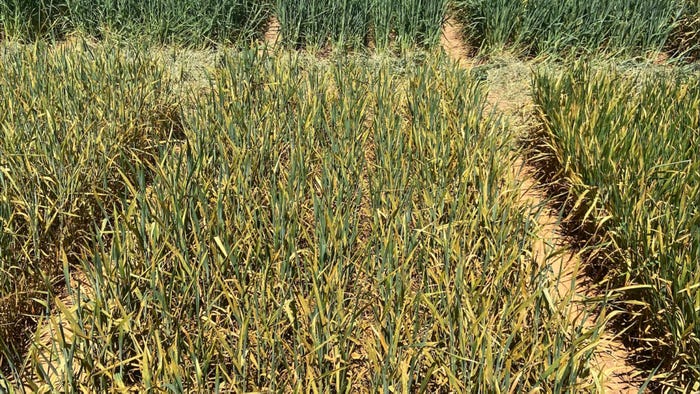
Wheat streak mosaic virus will be the primary focus, Rush said, along with Triticum mosaic virus and High Plains virus. All three viruses are vectored by the wheat curl mite and cause similar disease symptoms on infected wheat plants. The mite can’t fly but is carried by the wind from plant to plant, and there is no chemical control at this time.

“To control the diseases caused by these viruses, we really have to learn to control the mite,” he said.

Dr. Gary Hines, a University of Nebraska entomologist, is the program director. Rush said he and Hines have been talking for years about this project and have finally pulled everything together.

The scientists plan to determine the impact of environmental conditions, alternate hosts and management tactics on mite populations and disease incidence, as well as the risk in geographically and environmentally diverse production regions across the Great Plains.

They will identify the primary interactions that occur in this wheat-mite-virus complex across the region and increase producer implementation of integrated management principles for managing the complex across the Great Plains, Rush said.

Discuss this Article 0

Post new comment
Sign In or register to use your Southwest Farm Press ID

(optional)

Continuing Education Courses
This CE course is accredited for hours in Texas, Oklahoma and New Mexico. The content focuses...
New Course
The 2,000 member Weed Science Society of America’s (WSSA) Herbicide Resistance Action...
New Course
The course details six of the primary diseases affecting citrus: Huanglongbing (Citrus...

Newsletter Signup