Guidelines offered for nitrogen management

Sep 9, 2008 11:48 AM, By Ron Smith
Farm Press Editorial Staff

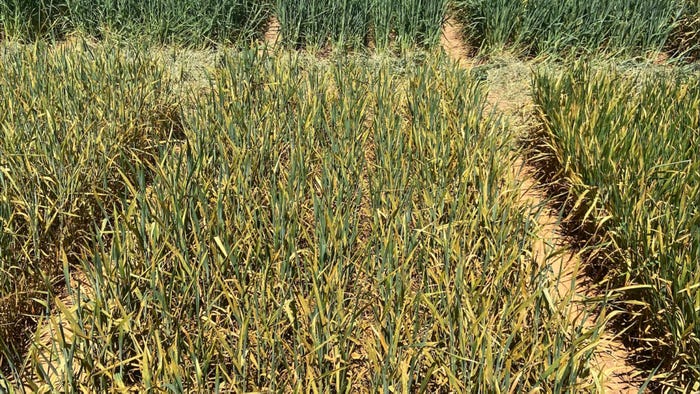
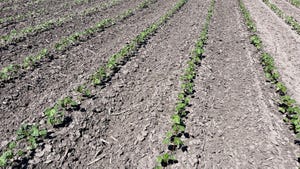
Reference strips, N-Rich strips or N-Ramps can provide wheat and other crop farmers vital information for accurate nitrogen fertilization in season. N-Rich strips have enough nitrogen applied to guarantee non-nitrogen-limited conditions. N-Ramps include small rate studies in fields. Growers can use sensors or visual determination to gauge nitrogen need.

Oklahoma State University offers the following guidelines for establishing reference strips.

– Pick a location that best represents the entire field.

– Strips may be placed in multiple areas of a field.

– Do not place the strips in the best or worst part of the field.

– Put out the strips at or before sowing the crop.

– Wheat strips can be put out a month before sowing.

– Don’t wait until mid-December to put the strips in.

– Apply a pre-plant fertilizer, approximately 40 pounds of nitrogen per acre for grain only and 80 pounds of nitrogen per acre for dual-purpose wheat.

– Producers can band fertilizer with seed and reduce pre-plant rate.

– Don’t skip applying preplant fertilizer unless soil test nitrogen is high.

For in-season analysis of reference strips, OSU recommends:

– Try to sense as close to hollow stem as possible.

– Can sense earlier if days where GDDs (number of days since planting that temperatures were warm enough for wheat to grow) greater than zero are more than 80.

– Don’t sense early if little forage has been produced.

– Use the sensor for most accurate nitrogen rate prescription.

– Growers may use visual determination for N-Ramps.

– Don’t waste money by not using N-Rich strips or N-Ramps.

For dual-purpose wheat, growers should pull cattle off two weeks before sensing. They may choose to fence off areas around strips for two weeks prior to sensing. They should not pull off cattle and sense the same day.

email: rsmith@farmpress.com

Get Copyright ClearanceWant to use this article? Click here for options!
© 2009 Penton Media, Inc.


Latest Jobs

resources

events icon events

product info icon tradeshows

tradeshow icon digests

research icon photos

Continuing Education

Accredited in Florida, Georgia, New Mexico, Oklahoma, Texas, South Carolina and Tennessee:


(New Course)
Weed Resistance Management in Cotton

This course covers a wide range of options to effectively control weeds in cotton and reduce the risk of weed resistance management. It is accredited for hours/units for licensed/accredited applicators in 7 U.S. Cotton Belt states (Florida, Georgia, New Mexico, Oklahoma, Texas, South Carolina an d Tennessee. CCA credit is pending).

(New Course)
New Mode of Action Chemistry for Vegetable Production

Integration of a new mode of action compound like Coragen into IPM and IRM programs to control Lepidoptera in leafy greens, fruiting vegetables, peppers and brassica or cole crops is always welcome. This online CE accredited course details how best to use this new mode of action insecticide in intensive vegetable production. It is accredited by the Certified Crop Adviser (CCA) program and by state agencies for licensed applicators in Texas, Georgia, Florida, New Jersey and Pennsylvania.

This course is accredited in Texas, Oklahoma, New Mexico, Virginia, West Virginia and Wyoming as well as for CCA credits:

(New Course)
Spray Drift Management

Keeping crop protection chemicals on the crop for which they are intended has been a cornerstone of farming not only to protect neighboring crops, but to not waste money allowing products to drift off the intended target. This accredited online continuing education course covers the critical elements of spray drift management.

Back to Top

Browse Print Issues

Additional Resources

subscribe to Farm Press Daily Delta Farm Press Southeastt Farm Press Western Farm Press