If properly timed and disease a present threat: Wheat fungicides good investment

Aug 4, 2005 12:00 PM, By Molly Mason Farm Press Editorial Staff

Spraying wheat could pay off. Texas A&M-Commerce researchers monitoring relationships between fungicides, increased disease pressure, and doubled crop yields say studies support judicious use of fungicides.

“If a fungicide is properly timed and the disease is a present threat, a $2.50 return on every dollar spent is likely,” says Jim Swart, Extension integrated pest management specialist at Texas A&M-Commerce.

Swart has been working with wheat disease for more than 20 years.

In 1984, Swart and Don Reid, professor of agronomy, began doing applied research with foliar fungicides.

Swart says, “The two main diseases limiting high yields in wheat crops are leaf rust and stripe rust.”

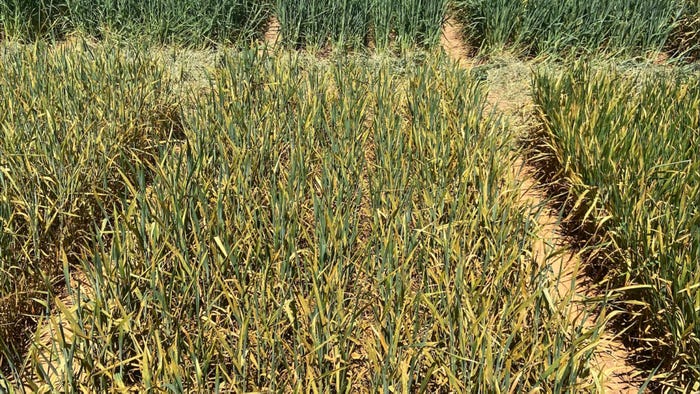
Stripe rust was a particularly prominent threat in Northeast Texas this year. Some crops treated actually doubled in yield. Leaf rust posed less of a threat this season but, with fungicide applications, yield increase was still substantial, up 30 percent to 40 percent, says Swart.

Alton Norman, Howe, Texas, wheat producer, says the last two years fungicides increased yields, improved test weights, and strengthened wheat straw.

Norman sprays a split application of Quilt — 7 ounces early in the growing season and 7 ounces six weeks later — on susceptible varieties, Pioneer 25R78 and 2549, which tend to rust earlier than 2557. “One 14-ounce application of Quilt is adequate for 2557,” he says.

Larger spray tips

Norman recommends changing to larger spray tips and removing some strainers when applying Quilt. “We had a little difficulty with stopped-up tips and screens,” he says.

Timing also affects fungicide efficiency.

“You want to spray ahead of the disease, but if you're too early the material will not be around to protect the flag leaf during the critical grain filling period,” says Swart. He advises applying the treatment as late as possible in the growing season because a single fungicide application will only offer 25 days of leaf protection.

He and Reid have been experimenting with split applications of fungicides at reduced rates with good success. The fungicides studied in recent years include Quilt, Stratego, Headline, propiconazole (Tilt, Propimax), and Folicur. All these materials have provided good to excellent disease control and, except for Folicur, are labeled for wheat.

Fungicides appear to be a good investment. Swart says spending $14 per acre for fungicides to control leaf rust could increase returns as much as $35. Even greater returns are possible when fungicides are used to protect the crop from an early stripe rust infection.

“It's a judgment call on whether to use fungicides or not, but it looks like we'll have to spray every year now to help with quality,” says Norman.

Get Copyright ClearanceWant to use this article? Click here for options!
© 2009 Penton Media, Inc.


Latest Jobs

resources

events icon events

product info icon tradeshows

tradeshow icon digests

research icon photos

Continuing Education

Accredited in Florida, Georgia, New Mexico, Oklahoma, Texas, South Carolina and Tennessee:


(New Course)
Weed Resistance Management in Cotton

This course covers a wide range of options to effectively control weeds in cotton and reduce the risk of weed resistance management. It is accredited for hours/units for licensed/accredited applicators in 7 U.S. Cotton Belt states (Florida, Georgia, New Mexico, Oklahoma, Texas, South Carolina an d Tennessee. CCA credit is pending).

(New Course)
New Mode of Action Chemistry for Vegetable Production

Integration of a new mode of action compound like Coragen into IPM and IRM programs to control Lepidoptera in leafy greens, fruiting vegetables, peppers and brassica or cole crops is always welcome. This online CE accredited course details how best to use this new mode of action insecticide in intensive vegetable production. It is accredited by the Certified Crop Adviser (CCA) program and by state agencies for licensed applicators in Texas, Georgia, Florida, New Jersey and Pennsylvania.

This course is accredited in Texas, Oklahoma, New Mexico, Virginia, West Virginia and Wyoming as well as for CCA credits:

(New Course)
Spray Drift Management

Keeping crop protection chemicals on the crop for which they are intended has been a cornerstone of farming not only to protect neighboring crops, but to not waste money allowing products to drift off the intended target. This accredited online continuing education course covers the critical elements of spray drift management.

Back to Top

Browse Print Issues

Additional Resources

subscribe to Farm Press Daily Delta Farm Press Southeastt Farm Press Western Farm Press