Share

Remote sensing to increase peanut yields

Dec 9, 2009 9:54 AM, By Audry Olmsted, New Mexico State University

New Mexico State University researchers are working on a method of monitoring peanuts in the field in order to help growers produce a healthier crop.

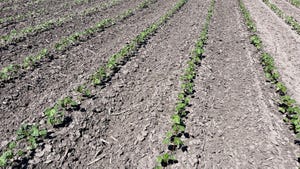
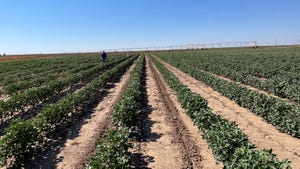
RESEARCHERS with New Mexico State University and Texas Tech University used remote sensing on peanut crops to determine crop ground cover, leaf area index, biomass and yield. (Photo courtesy of Naveen Puppala)

NMSU’s Agricultural Science Center at Clovis is collaborating with Texas Tech University to use remote sensing on peanut crops to estimate the biophysical characteristics, such as ground cover, leaf area index, biomass and yield.

“This is the first year we are using the method of remote sensing on peanuts and, since the peanut ground coverage is so dense, we are excited to see the results,” said Naveen Puppala, a peanut breeder at the Clovis center.

Puppala, along with Nithya Rajan and Stephan Maas, researchers with Texas Tech, have been observing a peanut crop near Brownfield, Texas, since the beginning of the growing season in May. They use the Texas Tech Airborne Multispectral Remote Sensing System flown aboard an aircraft provided by South Plains Precision Ag in Plainview, Texas.

The remote sensing system contains high-resolution digital cameras fitted with narrow band-pass filters that allow the cameras to acquire imagery in specific wavelengths of light.

Digital data extracted from the remote sensing imagery is used to calculate the values of vegetation indices, including the Normalized Difference Vegetation Index (NDVI) and the Perpendicular Vegetation Index (PVI) for the peanut canopies growing in plant-configuration test plots. Both NDVI and PVI are indicators used to measure a plant’s growth and leaf-canopy density. These indices are then compared with ground measurements of the biophysical characteristics of the plots when remote sensing observations are conducted.

This is the first year the Clovis science center has used remote sensing on peanuts, but the method can be used on a variety of crops. Rajan and Maas have previously used this method with success on cotton, sorghum and corn in West Texas.

Puppala and his collaborators chose to use a test site in West Texas because the area has seen growth in the peanut production. He has plans to apply the remote sensing method in New Mexico.

Development of relationships between biophysical characteristics and remote sensing data could allow routine monitoring of peanut crop growth and yield potential in producers’ fields.

“With more research on remote sensing, it will help the growers to identify the correct time to irrigate their crops,” Puppala said. “Growers can identify low-lying and deficient areas within their pivots. Peanut growers spend a lot of money on fungicides to control the foliar disease, but with remote sensing we can avoid areas where the crop is good and pinpoint or apply fungicides only to areas that are nutrient deficient or have problems with disease.”

email: aolmsted@nmsu.edu

Get Copyright ClearanceWant to use this article? Click here for options!
© 2010 Penton Media, Inc.


Latest Jobs

resources

events icon events

product info icon tradeshows

tradeshow icon digests

research icon photos

Continuing Education

Accredited for Certified Crop Adviser (CCA) units and hours/credit in Texas, New Mexico, Oklahoma, Tennessee, South Carolina, Virginia, Florida, Georgia, Maine and Delaware:


Weed Resistance Management in Cotton


This course covers a wide range of options to effectively control weeds in cotton and reduce the risk of weed resistance management. It is accredited for hours/units for licensed/accredited applicators in 7 U.S. Cotton Belt states (Florida, Georgia, New Mexico, Oklahoma, Texas, South Carolina an d Tennessee. CCA credit is pending).

Accredited for continuing education/recertification hours/units for pest control advisers/licensed applicators in California, Arizona, Georgia, Texas, Florida, Virginia, Pennsylvania, New Jersey, Delaware, Oregon, Maine, Washington and for Certified Crop Advisers:


New Mode of Action Chemistry for Vegetable Production

Integration of a new mode of action compound like Coragen into IPM and IRM programs to control Lepidoptera in leafy greens, fruiting vegetables, peppers and brassica or cole crops is always welcome. This online CE accredited course details how best to use this new mode of action insecticide in intensive vegetable production. It is accredited by the Certified Crop Adviser (CCA) program and by state agencies for licensed applicators in Texas, Georgia, Florida, New Jersey and Pennsylvania.

This course is accredited in Texas, Oklahoma, New Mexico, Virginia, West Virginia and Wyoming as well as for CCA credits:


Spray Drift Management

Keeping crop protection chemicals on the crop for which they are intended has been a cornerstone of farming not only to protect neighboring crops, but to not waste money allowing products to drift off the intended target. This accredited online continuing education course covers the critical elements of spray drift management.

This course is accredited for CE hours/units in California, Arizona, Florida, Georgia, Texas, Oklahoma, New Jersey, Delaware, Maryland and for Certified Crop Advisers.:


The ABCs of MRLs

American agriculture exports 20 to 30 percent of its production annually. For specific commodities, the percentage is much higher. When recommending and applying pest management products for crops, license Pest Control Advisers (PCAs) and applicators and farmers must be aware of which products applied are in compliance with Maximum Residue Limits (MRLs) established by foreign customers. This CE course details the MRL issue and why compliance is critical to marketing into world trade.

Back to Top

Browse Print Issues

Additional Resources

subscribe to Farm Press Daily Delta Farm Press Southeastt Farm Press Western Farm Press