Researcher’s focus: Eyeing more efficient cotton irrigation strategies

Feb 5, 2007 1:24 PM, By Cary Blake and Ron Smith
Farm Press Editorial Staff

Jim Bordovsky has dedicated most of the last three decades to figuring out better ways to irrigate crops on the Texas High Plains, dating all the way back to moving pipe as a high school student.

He’s spent more than 25 years doing research on the unique challenges High Plains farmers face with a diminishing water supply, higher pumping costs and potential changes in pumping policies.

Bordovsky discussed some of these changes and ways to increase irrigation efficiency during a recent presentation at the Beltwide Cotton Conferences in New Orleans.

“Systems have changed dramatically over the past 30 years,” Bordovsky said. Current strategy for most irrigated cotton farms, he said, is to improve efficiency.

Irrigation availability for cotton ranges from 0 to 0.3 inches per day in a region that gets only 18 inches of annual rainfall. “If we’re lucky, we’ll get 10 inches to 12 inches of rain in the growing season,” he said.

“The value of water is increasing as the Ogallala Aquifer is depleted. We have to move to more efficient systems.”

Bordovsky’s research priorities include developing cotton irrigation strategies featuring more efficient delivery systems, improved management and performance of existing systems, and reduced non-water production limitations.

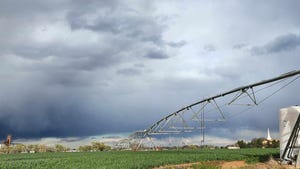
Seven years of studies have focused on small plot irrigation systems comparing spray, low energy precision application (LEPA), and subsurface drip systems. Larger plot tests have compared LEPA to low elevation spray applications (LESA) at the AG-CARES facility at Lamesa. Field scale research at the experiment station near Plainview includes about 70 acres of sub-surface drip and 120 acres of pivot irrigated cotton.

“From these tests, we can generally define an application efficiency for each type of irrigation system. Surface systems can be very efficient,” said Bordovsky. “Spray systems provide a much higher degree of water control. LEPA reduces evaporation losses over spray systems.” Yet topography limits the number of acres available for LEPA application.

Bordovsky said farmers are moving away from furrow systems to spray, LEPA, and sub-surface drip systems on the High Plains.

Need to improve

“We need to improve management and performance of our current irrigation systems,” he said. Several studies across the Cotton Belt have focused on irrigation requirements such as timing, water losses, site-specific applications, and cotton physiology related to different systems.

“We should concentrate on applying water when the plant needs it, vs. storing it on the surface for later use or storing in the profile,” Bordovsky said. “In an experiment featuring six different treatments of three different irrigation systems plus two pre-plant scenarios, the result showed a much higher water value by applying in season.”

More than a million High Plains acres feature spray systems with the opportunity to reduce evaporative losses by using narrow row plantings. “We’ve had some problems with narrow row plantings, primarily with weeds and harvest. We’ve pretty much taken care of the weed problems but still have some harvest issues. Better harvesting equipment adapted to narrow rows is helping.”

He said innovative producers on the High Plains have constructed and have in use a 20-inch stripper that has worked successfully over several hundred acres. The result: increased water value.

Accurate irrigation scheduling also improves water-use efficiency. Bordovsky said local evapotranspiration-based scheduling information is available to many producers through daily sources. Soil moisture-monitoring equipment is increasingly more sophisticated and is becoming more user friendly. He said better monitoring technology would increase farmers’ ability to schedule irrigation following rainfall and at the end of the growing season.

Several years of site-specific irrigation testing has increased some yields with variable rate application vs. uniform rate application, but without a consistent increase in water use efficiency.

Most efficient

Bordovsky said subsurface drip irrigation (SDI) is the most efficient in-season system available.

“After five years of testing, high input management in dry years increased water yield and irrigation water use efficiency compared to normal input levels. In wet years, the inverse is true,” Bordovsky said.

In some cases seed germination with SDI has been poor, which means lower water value.

“We hypothesize that we can pull water up from the drip tape into the seed bed for germination,” Bordovsky said. “Our experiments examine different soil amendments using soil sensors in treatment areas protected from rainfall and then irrigating with sub-surface drip.”

Bordovsky said cotton farmers may find it difficult to stay on the same drip irrigation rows year after year. He’s looking at the effect on yield of drip tape offset away from rows. In one example, a field has a drip line 10 inches and then 20 inches away from the rows. Early results show moving greater than five inches away from the drip line is reducing yield and water value.

Another factor in water-use efficiency is reducing the non-water production limitations—selecting the wrong variety, making mistakes on in-season crop management, and failing to provide adequate insect control.

“If water value is the critical input, we do not want to limit yield by choosing the wrong varieties, not having the appropriate nutrient levels or nutrient types or failing with pest controls,” Bordovsky said.

“Our goal is to move toward more efficient irrigation systems as economics allow. We want to improve management performance of current systems and reduce non-water production limitations,” he said.

email: cblake@farmpress.com

email: rsmith@farmpress.com

Get Copyright ClearanceWant to use this article? Click here for options!
© 2010 Penton Media, Inc.


Latest Jobs

resources

events icon events

product info icon tradeshows

tradeshow icon digests

research icon photos

Continuing Education

Accredited in Florida, Georgia, New Mexico, Oklahoma, Texas, South Carolina and Tennessee:


(New Course)
Weed Resistance Management in Cotton


This course covers a wide range of options to effectively control weeds in cotton and reduce the risk of weed resistance management. It is accredited for hours/units for licensed/accredited applicators in 7 U.S. Cotton Belt states (Florida, Georgia, New Mexico, Oklahoma, Texas, South Carolina an d Tennessee. CCA credit is pending).

(New Course)
New Mode of Action Chemistry for Vegetable Production

Integration of a new mode of action compound like Coragen into IPM and IRM programs to control Lepidoptera in leafy greens, fruiting vegetables, peppers and brassica or cole crops is always welcome. This online CE accredited course details how best to use this new mode of action insecticide in intensive vegetable production. It is accredited by the Certified Crop Adviser (CCA) program and by state agencies for licensed applicators in Texas, Georgia, Florida, New Jersey and Pennsylvania.

This course is accredited in Texas, Oklahoma, New Mexico, Virginia, West Virginia and Wyoming as well as for CCA credits:

(New Course)
Spray Drift Management

Keeping crop protection chemicals on the crop for which they are intended has been a cornerstone of farming not only to protect neighboring crops, but to not waste money allowing products to drift off the intended target. This accredited online continuing education course covers the critical elements of spray drift management.

New Course
The ABCs of MRLs

American agriculture exports 20 to 30 percent of its production annually. For specific commodities, the percentage is much higher. When recommending and applying pest management products for crops, license Pest Control Advisers (PCAs)  and applicators and farmers must be aware of which products applied are in compliance with Maximum Residue Limits (MRLs) established by foreign customers. This CE course details the MRL issue and why compliance is critical to marketing into world trade.

Back to Top

Browse Print Issues

Additional Resources

subscribe to Farm Press Daily Delta Farm Press Southeastt Farm Press Western Farm Press