Topguard exemption gives cotton new root rot control tool

  • Raising cotton without root rot infestations could mean additional 2 cents to 4 cents a pound.
  • Ongoing research will look at ways to increase efficiency and save money.
  • Topguard is not a reason to go to a monoculture. Farmers still have to consider other pests, such as nematodes.


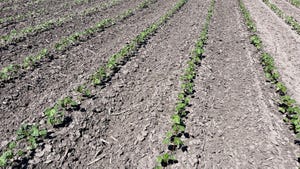
A T-BAND 5-inch at-planting application is the labeled method of applying Topguard fungicide, recently approved through a Section 18 emergency use label for Texas cotton.

Research continues

“We’re not finished,” Isakeit says. “Last year, because of the drought, was not a good year to test root rot control. We had a lot of experiments set up but with drought, we had no disease in many locations.”

He says ongoing research will look at ways to increase efficiency and save money. “It’s possible that we can reduce the amount of chemical applied,” he says. “It’s labeled at 1 to 2 pints per acre but we’ve seen best efficacy at the higher end of the range.”

He hopes continuing trials will show better application methods that will allow farmers to reduce application rates without sacrificing control.

The T-band application method has been adopted to prevent phytotoxicity. “We haven’t seen that in our trials,” Isakeit says, “but Cheminova (the manufacturer) found phytotoxicity in trials where they applied in-furrow and then had a rain soon after planting.” That application method will be one area of study. Currently, application with a T-band is the only labeled method.

He recommends that farmers follow the label exactly. “We don’t want them doing their own trials. They should get with their county Extension agents and let them help set up something,” he says.

Isakeit also plans to install sensors in some fields to monitor moisture and temperature to determine the correlation between those factors and incidence of the root rot fungus.

The recent exemption approval was “timely, even for the Valley, where they are just beginning to plant,” Isakeit says.

He and Minzenmayer urge farmers not to depend solely on Topguard to control root rot. “We were limited before. Rotation was about the only option farmers had to deal with root rot. And cotton was usually the best crop for irrigated acreage. But rotation will still help,” Minzenmayer says. “Cotton on cotton is not the best option.”

“We still need to follow a good IPM program,” Isakeit adds. “Crop rotation should be part of the overall cotton management strategy. Topguard is not a reason to go to a monoculture. Farmers still have to consider other pests, such as nematodes.”

Minzenmayer says root rot is a particularly damaging disease because symptoms come on late. “It doesn’t show until the bloom period and by then farmers have almost all their inputs out. In some cases, losses can be 50 percent to 60 percent.”

Harvest can be a big challenge, too, with dead stalks clogging machinery as well as reducing quality.

Isakeit says root rot does not occur in the Texas High Plains and has been only a minor problem in East Texas, where little cotton is grown any more.

“But we see pockets all over the rest of the state,” he says. “Thousands and thousands of acres are infected with root rot. Some growers have only a little; others have a lot.”

Discuss this Article 0

Post new comment
Sign In or register to use your Southwest Farm Press ID
(optional)

Continuing Education Courses
This CE course is accredited for hours in Texas, Oklahoma and New Mexico. The content focuses...
New Course
The 2,000 member Weed Science Society of America’s (WSSA) Herbicide Resistance Action...
New Course
The course details six of the primary diseases affecting citrus: Huanglongbing (Citrus...

Newsletter Signup