Peterson, Combest agree: Congress will likely pass Farm bill before Christmas

Nov 30, 2007 10:10 AM, By Ron Smith
Farm Press Editorial Staff

The United States Congress could provide the nation’s farmers a timely Christmas present by passing a farm bill before the holiday recess.

“The U.S. House of Representatives set out to get a farm bill done on time (before the 2002 Farm Security and Rural Investment Act of 2002 expired September 30),” said Representative Collin Peterson, D-Minnesota, and chairman of the House Agriculture Committee.

Peterson, speaking via telephone hookup to the seventh annual Texas Commodity Symposium in Amarillo this week, said the bill “got bogged down in the Senate. It’s a petty good bill, not perfect, but nutrition, conservation and renewable fuels will be happy with it.”

He said the Senate version of the bill is close to what the House passed and is bi-partisan. The problem, he said, was attempts to attach amendments to the bill. “They’re trying to limit amendments and appear to be close to a deal. We hope to see an agreement next week.”

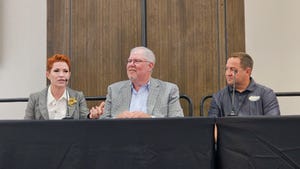
Larry Combest, retired Texas Congressman, one of the chief authors of the 2002 legislation, who continues to work for responsible farm legislation through a newly formed Southwest Ag Council and with Combest Sell and Associates, predicted Senate passage before Christmas.

“They will not get conferees together before January, however,” Combest said. Best estimate, he and Peterson agreed, would be in January with a final bill ready to send to the White House by early March.

Peterson, responding to a question by Plains Cotton Growers, Inc. executive vice president Steve Verett, said the process could stretch out until late March or early April before Congress would be forced to push for extension of current law. The dairy program, however, will be extended, he said. “The dairy price support program expires December 31 and if we do not extend the program it reverts back to permanent law.”

Combest said the next budget cycle, in late February, would be the next catalyst to push Congress to either pass a new bill or extend the current one.

Both Peterson and Combest expect a payment limitations proposal to pass the Senate. They said efforts to defeat the proposal will continue but chances of it passing will be good. “USDA is fixated on payment limitations,” Peterson said.

“We will not accept it. They (Grassely and Dorgan) are off on the wrong track and are playing politics.”

He said more legislators support limiting payments on non-farmers. “But southern farmers can’t live with payment limitations,” he said.

Even if Congress passes a bill it still faces threat of a presidential veto. “That’s a problem,” Peterson said. “He threatened to veto the bill in 2002 but he did not and took credit for it. I hope to have a discussion with the president.”

Combest said many of the same advisors that opposed the 2002 bill are still in the administration. “Many are not. I hope the President who signed the 2002 bill will step up and sign this one.”

Peterson said the bill will face other hurdles in Ways and Means where many committee members are “not keen on agriculture.”

Peterson said an energy bill may make it through both houses before the farm legislation. “We’re negotiating for an increased renewable fuels standard (above 9 million gallons per year, up from the current 7 million). We can get to 9 million in 12 to 18 months,” he said.

Peterson said he remains optimistic that congress will pass a farm bill to “preserve the safety net and increase conservation and nutrition programs.”

email: rsmith@farmpress.com

Get Copyright ClearanceWant to use this article? Click here for options!
© 2009 Penton Media, Inc.


Latest Jobs

resources

events icon events

product info icon tradeshows

tradeshow icon digests

research icon photos

Continuing Education

Accredited in Florida, Georgia, New Mexico, Oklahoma, Texas, South Carolina and Tennessee:


(New Course)
Weed Resistance Management in Cotton

This course covers a wide range of options to effectively control weeds in cotton and reduce the risk of weed resistance management. It is accredited for hours/units for licensed/accredited applicators in 7 U.S. Cotton Belt states (Florida, Georgia, New Mexico, Oklahoma, Texas, South Carolina an d Tennessee. CCA credit is pending).

(New Course)
New Mode of Action Chemistry for Vegetable Production

Integration of a new mode of action compound like Coragen into IPM and IRM programs to control Lepidoptera in leafy greens, fruiting vegetables, peppers and brassica or cole crops is always welcome. This online CE accredited course details how best to use this new mode of action insecticide in intensive vegetable production. It is accredited by the Certified Crop Adviser (CCA) program and by state agencies for licensed applicators in Texas, Georgia, Florida, New Jersey and Pennsylvania.

This course is accredited in Texas, Oklahoma, New Mexico, Virginia, West Virginia and Wyoming as well as for CCA credits:

(New Course)
Spray Drift Management

Keeping crop protection chemicals on the crop for which they are intended has been a cornerstone of farming not only to protect neighboring crops, but to not waste money allowing products to drift off the intended target. This accredited online continuing education course covers the critical elements of spray drift management.

Back to Top

Browse Print Issues

Additional Resources

subscribe to Farm Press Daily Delta Farm Press Southeastt Farm Press Western Farm Press