Bipartisan effort seen as crucial for advantageous farm bill

May 26, 2006 9:07 AM, By Ron Smith

The United States can’t “unilaterally disarm” in trade negotiations before an agreement is reached with trading partners.

The most important ingredient in a recipe for another good farm bill, according to former U.S. Representative Larry Combest, may be hard to find in Washington.

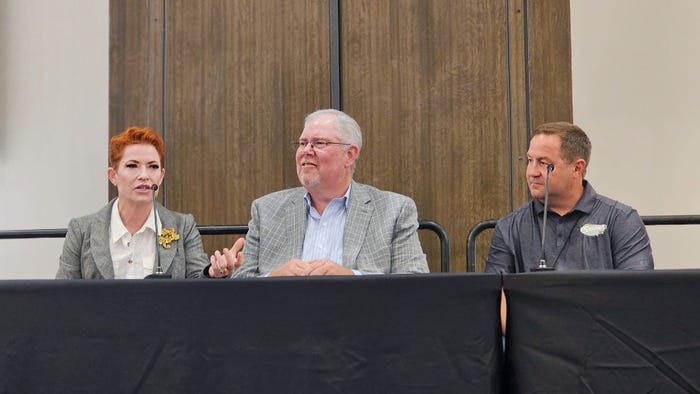
“Bipartisanship is rare and getting rarer,” Combest told participants in the Texas Cotton Association’s 95th annual convention recently in South Padre Island, Texas.

Combest, in the keynote address, cited bi-partisan support as the best chance of getting “the best program possible.”

He said the Freedom to Farm Act of 1996, for instance, was developed in a “divisive, partisan” atmosphere. Congress “was sharply divided along party lines. Four of us (House Republicans) felt that bill was not in the best interest of agriculture and we voted against it. We were called turncoats and renegades but we represented our constituency and did not follow party lines.”

He said one of the four, Saxby Chambliss, now serves as chairman of the Senate Agriculture Committee. And Combest chaired the House Agriculture Committee and ushered through the Farm Security and Rural Investment Act of 2002, often hailed as one of the best farm bills in memory.

“Freedom to Farm was not popular and I decided as chairman of the House Agriculture Committee that we would move away from that program in the 2002 bill,” he said.

When he went to Congress, Combest said he wanted to be chairman of the House Agriculture Committee and to write a farm bill. “When I had done that it was time to move on,” he said.

He said he knew that agriculture “needed a broad base of support among the people it would affect. We’ve heard a lot of myths about farm programs, usually from people who don’t like farm programs and don’t understand them. We had to recognize enemies and make allies out of them. We recognized the need for balance.”

Combest said the 2002 law came about because agriculture garnered support from nutrition and conservation interests.

“When we held field hearings we required that testimony be specific and if it was not we did not allow the testimony. Five years into the program, we still get overwhelming support for the act. That does not make me feel bad. The program works.”

Combest recalls a long visit with President Bush before the bill went to a vote. “I explained why it was good policy and by the end of the visit he agreed.”

He said just before the bill was up for a vote in the Senate, President Bush instructed Senate leaders to make their farm bill as much like the House bill as possible.

Agricultural interests have some “substantial lifting” to achieve a good bill in 2007. Agriculture must “develop a strategy that comes up with a bill with deep support,” he said.

Agriculture funding faces significant challenges that did not exist in 2002. “We had a budget surplus in 2002. In 2006, we will not (have a surplus). That must be a consideration.”

Combest said no bill will pass without substantial Democratic support. “Odds favor Republicans maintaining control of both houses after the November elections,” he said. “But margins will be much narrower. It will be virtually impossible to pass anything without bipartisan support.”

He said trade legislation is about as likely to happen as “privatizing Social Security”

and that no alternative farm bill “will come close to satisfying (farmers) like the current one.”

Extending that bill may be possible. “I think through September, if Congress had an opportunity for an up or down vote on extending the farm bill it would pass. But we may see efforts to attach it to a conference report.”

He said pressure to leave the law in place may increase closer to November and “will still exist as we get into 2007.”

Combest said the United States can’t “unilaterally disarm” in trade negotiations before an agreement is reached with trading partners.

He’s “still interested” in farm programs but sees a “high level of frustration,” in Congress.

“It’s a volatile situation and not a good opportunity to get much done.”

But he’s optimistic for farm program stability. “I don’t see a lot of basic structure changes. The program has worked. We saved $17 billion the first three years of the farm bill and we only account for one-half of 1 percent of the national budget. Cuts to agriculture don’t mean a lot to overall savings.”

But he recommends farmers and their associations remain vigilant as discussions continue. “Be involved,” Combest said. “There are always those working on the other side of the issue.” He said those organizations are well funded and committed.

“You can’t assume that someone else will do the work for you,” he said. “And agriculture must speak with a common voice. Differences of opinion will exist but at the end of the day, ag has to come together. If individuals split off, (achieving a good bill) is almost impossible.”

e-mail: rsmith@farmpress.com

Get Copyright ClearanceWant to use this article? Click here for options!
© 2009 Penton Media, Inc.


Latest Jobs

resources

events icon events

product info icon tradeshows

tradeshow icon digests

research icon photos

Continuing Education

Accredited in Florida, Georgia, New Mexico, Oklahoma, Texas, South Carolina and Tennessee:


(New Course)
Weed Resistance Management in Cotton

This course covers a wide range of options to effectively control weeds in cotton and reduce the risk of weed resistance management. It is accredited for hours/units for licensed/accredited applicators in 7 U.S. Cotton Belt states (Florida, Georgia, New Mexico, Oklahoma, Texas, South Carolina an d Tennessee. CCA credit is pending).

(New Course)
New Mode of Action Chemistry for Vegetable Production

Integration of a new mode of action compound like Coragen into IPM and IRM programs to control Lepidoptera in leafy greens, fruiting vegetables, peppers and brassica or cole crops is always welcome. This online CE accredited course details how best to use this new mode of action insecticide in intensive vegetable production. It is accredited by the Certified Crop Adviser (CCA) program and by state agencies for licensed applicators in Texas, Georgia, Florida, New Jersey and Pennsylvania.

This course is accredited in Texas, Oklahoma, New Mexico, Virginia, West Virginia and Wyoming as well as for CCA credits:

(New Course)
Spray Drift Management

Keeping crop protection chemicals on the crop for which they are intended has been a cornerstone of farming not only to protect neighboring crops, but to not waste money allowing products to drift off the intended target. This accredited online continuing education course covers the critical elements of spray drift management.

Back to Top

Browse Print Issues

Additional Resources

subscribe to Farm Press Daily Delta Farm Press Southeastt Farm Press Western Farm Press